 |
Basic Call to Consciousness

Intention

Invented White History & Imagery

In the Beginning

First Nations Governance

Trail of Tears

Tragedy of Little Bighorn

Massacre at Wounded Knee

Duwamish/Suquamish Displacement

Cultural Genocide

Native Values

Impact of European Immigrants

The Take-over

Called ‘Indian’ or....

Cultural Genocide - Boarding schools

Native Values & Way of Life

Morality

Depression & Substance abuse

Cultural Distinctions

Spiritual Sensibilities

Language

Living Two Lives

Leaders or Rulers

Written or Oral

Painful History

Iroquois Conservation

Chief Seattle’s Farewell Speech

Spirit Road

|
 |
A tragedy has taken place on our land, and even though it did not take place on our watch, we are its inheritors, and the earth remembers.

The People Native to this land known to a number of tribes as Turtle Island - in what is now called America - tell their own experiences of the events that occurred on this land upon which they love and revere.
What do we really know about these sons and daughters of the Natural World? The Ancestors, living prior to the ‘take-over’ by the white man, all over the continent live in a level of harmony with the environment that we can barely imagine now--true conservationists. Their’s is a rich cultural history, with stories and ceremonies of reverence for the land upon which they lived and prayed in gratitude for the natural resources that sustained them for thousands of years. What we may know of their cultural roots and philosophies of life is tainted by commercial romanticism, often exploited and twisted beyond recognition for novelty value and negative stereotyping. Examine the faces of the People in their photo images, below; you will notice poised individuals exhibiting a sense of inner presence. This site will trace back their stories exploring The People’s experiences at their source. Discover for ourselves their experiences--the way they were treated by exploitative hunters, trappers, politicians and the Bureau of Indian Affairs--causes these ancient people to walk the now alien soil of their native land with their heads held high and how we may learn from their reverence of Life to live more wisely together on our planet.

The intention of this material is in no way to speak for The First Nations Peoples--The Peoples indigenous to the North American continent for centuries prior to the arrival of the first European immigrants. Rather, here will be found a compilation of statements expressed or written by First Peoples. The themes expressed are repeated by speakers and authors from the many tribes all across this country and throughout the decades and centuries who lived on this land. Stories exemplifying the ways traditional First Peoples lived in accordance with their values--inwardly reflective and outwardly honoring great Nature and Mother Earth as central to their way of life. This site also reviews the true nature of the battles fought between First Nations and the white man--rather than battle-stories, we explore the reasons behind the battles. We, in this country are at a tipping point in our present relationship to Mother Earth. Rather than honoring Her as a sentient being who provides for her children, She is seen as a resource to be conquered and exploited. The true nature of these battles illustrates the oppression of other sovereign nations and exploitation of nature in our government’s history.

Living in a society that suffers from historical amnesia, how do we preserve the memory of a People Native to this land who have resisted and struggled over time for the ideas of freedom, democracy and equality as well as the conservation of Great Nature and her natural resources. Invented media images and negative stereotyping prevent millions of Americans from obtaining knowledge of critical events in American history and of current authentic human experience of First Nations People. We are called to unearth, piece together and interpret the experiences that can, then, come alive revealing what it has always been--a part of our present. In this way, we gain an expanded understanding the present, enabling us to move forward in a responsible way to the future. Otherwise, we remain trapped in beliefs of derisive stereotypes of the American frontier past, freeze dried and recycled as modern cultural myths - all of which were mostly established by white inventors of pejorative Indian images.
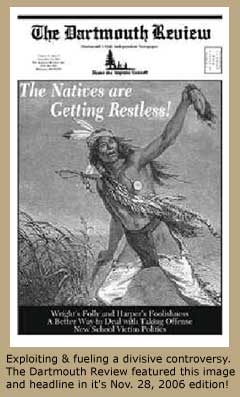
My intention for this site is offering information leading to correction in thinking and perception regarding a host of false assumptions concluded about First People by dominant society--perhaps unwittingly, and, leading to a re-evaluation of our own values that inform our choices in our way of living together a human beings and caring for this planet.

“Mitakuye Oyasin”, Lakota language expressing: All My Relations - humans, animals, plants and the earth - we are all related.

Research and creation of this site is a labor-of-Love. My motivation is simple--citizens of North American continent, with the increased consciousness in this new millennium, may come to a growing realization of our responsibility for our historical treatment of First People and exploitation of our planet. This information is offering a change of mind rather than blame. We will also observe how history continues to be repeated when we do not address the past and take corrective action in the present.

We live in a time when Mother Earth and her many children are struggling to survive. Our oldest custodians of the planet, the indigenous cultures of healing traditions, face the danger of extinction. We cannot afford a future without them. We cannot wait any longer to act. Quoting Bradford Keeney in Shaking Out the Spirits.
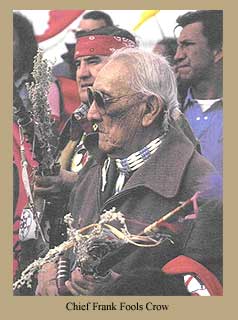
Chief Fools Crow, 1890-1989, Ceremonial Chief/Healer of the Teton Lakota band: “Survival of the world depends on our sharing what we have, and working together. If we don’t the whole world will die. First the planet, and next the people.” He continues, “The ones who complain and talk the most about giving away Medicine Secrets, are always those who know the least.”

Fools Crow was one of the last of The People born at the end of the 18 hundreds who never attended any of the white man’s institutions. A living expression of peace of mind that comes from innate wisdom of his ancestors, he had some powerful advice on how to become a positive force for change: Become a hollow bone--“To become a clean hollow bone [clean vessel] you must first live as I have...or begin to do it. You must love everyone, put others first, be moral, keep your life in order, not do anything criminal, and have good character. The visions and the ceremonies had only made me like a hole through which the power could come. If I thought that I was doing it myself, the hole would close up and no power could come through.”

Due to our modern world view many have lost touch with the natural world and its many wonders and gifts. By contrast, have you known a person who lives close to Nature--how they exhibit a spiritual grace and sense of peace. Many do not recognize that our Earth is a living organism. As a result, too many corporations with their focus on profit at any cost are allowed, through deregulation, continued destruction of our life-support system--our Earth: damaging Her lungs--the rain forests; killing off her children for profit--the wildlife across the continents; unhinging the delicate balance of our eco-system. Our elected officials stand idly by as the notion of ‘living organism’ is no more than a mere concept in their minds. However, increasing numbers of us sense that something is not right on our planet as strange weather, storms and fires create increasing devastation.
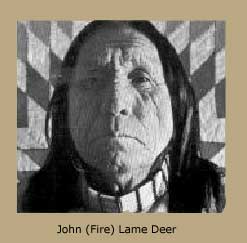
Lame Deer, Lakota Elder--1903-1976, speaks: “Our circle is timeless, flowing, it is a new life emerging from death-life winning out over death. When we look at the world in the manner which the Great Spirit designed it, we can see why it makes sense to live in harmony with Great Nature: the trees grow and bear fruit, the fruit has seeds, the seeds fall to the ground, the ground grows new trees, old trees die to make way for the young. Any time we think we can interrupt this cycle or change it we will experience turmoil and confusion. The Human Cycle exists as the baby becomes the youth, the youth becomes the adult, the adult has children, the adult becomes the Elder, and the Elder teaches the youth. Elders go on to the Spirit World. Spirit comes into babies to produce new life.”
Rolling Thunder, Cherokee Healer--“A very fundamental symbol in traditional Indian belief: the Circle. This figure, with its ultimate simplicity, was revered in many aboriginal religions--including ours--and its long been used as a symbol of the continuity of the Indian nation. Most so-called primitive peoples have dances that follow circles, and many of our important ceremonies and rituals are held in a circle formation. In fact, the circle is found everywhere in the natural world...the earth itself is a sphere...The continuity of that giant ring of life teaches us that the spirit of cooperation can start with us and loop around to include all living beings...we have no right to dirty up the planet with our trash. Therefore, the cleansing of the earth starts with the cleansing of our minds. We’ll have to clean up our own spirits before we can start cleaning up this land.” 1981

In our daily life, living in the wants of immediate gratification, too many are thinking only of satisfying ‘my need, now’--or, ‘how much money can I make?’ The media instructs what is new to buy--what we must have. Who is thinking of their great-grand children’s existence on this planet and the impact our lifestyle will have on these children? Who is thinking, today, of sufferings of the Generations Unborn will be exposed to as Great Nature expresses her corrective powers on the planet as we are already witnessing? First People reflected on the impact of their decisions seven generations into the future. Our government, however, supports UNconsciousness of such impact of our choices. There are others, however, being drawn to earth-based values and spirituality known to First People.

Basic Call to Consciousness
Basic Call to Consciousness, written THIRTY YEARS AGO by the Iroquois Federation of Northeast tribes, conveys a perspective that is both forthright and logical, pointing out that Western culture has been horribly exploitative and destructive of the natural world. Following is an excerpt:
|
“Human beings are abusing one another as well as the planet they live on. The destruction of the natural world is a clear indication of mankind’s spiritual poverty...Hundreds of species of birds and animals have been utterly destroyed since the Europeans arrived in America...The forests have been leveled, the waters polluted, the native peoples subjected to genocide...Western technology and the people who have employed it have been the most amazingly destructive forces in all of human history....

“The way of life known as Western civilization is on a death path, and its culture has no viable answers. The appearance of plutonium on this planet is the clearest of signals that our species is in trouble. It is a signal that most Westerners have chosen to ignore.

“We, Natives, think even the systems of weather are changing. Our ancient teaching warned us that if man interfered with the natural laws, these things would come to be. When the last of the Natural Way of Life is gone, all hope for human survival will be gone with it. And our Way of Life is fast disappearing, a victim of the destructive processes of so-called progress.

“We know that there are many people in the world who can quickly grasp the intent of our message. But experience has taught us that there are few that are willing to seek out a method for moving toward any real change. But if there is a future for all beings on this planet, we must begin seeking avenues of change.

“The people who are living on this planet need to break with the narrow concepts of human liberation and begin to see liberation as something that needs to be extended to the whole of the Natural World. What is needed is the liberation of all things that support life - the air, the waters, the trees - all the things that support the sacred Web of Life.

“We feel that the Native peoples of the Western Hemisphere can continue to contribute to the survival potential of the human species. The majority of our peoples still live in accordance with the traditions that find their roots in the Mother Earth. But the Native peoples have need of a forum where our voice can be heard. And we need alliances with other peoples of the world to assist in our struggle to regain and maintain our ancestral lands and to protect the Way of Life we follow.

“We know that this is a very difficult task. Many nation-states may feel threatened by the position that the protection and liberation of Natural World peoples and cultures represent, a progressive direction that must be integrated into the political strategies of people who seek to uphold the dignity of human beings. But that position is growing in strength, and it represents a necessary strategy in the evolution of progressive thought.

“Traditional First Nations Peoples hold the key to the reversal of processes in Western civilization that hold the promise of unimaginable future suffering and destruction. Spiritualism is the highest form of political consciousness. And we, First Peoples of the Western Hemisphere, are among the world’s surviving proprietors of that kind of consciousness. We are here to impart that message.

“Wake up. Our lives are part of a sacred web in which everything is connected. When we poison the air or the soil with our lifestyles and technologies, even just a little bit, we are poisoning ourselves.

“Our essential message to the world is a basic call to consciousness. The destruction of the native cultures and people is the same process which has and continues to destroy life on this planet. The technologies and social systems which have destroyed the animal and planet life are also destroying the Native People.

“Through this document, Native Americans are calling for...a shared ideology developed by all people using their purest and most unselfish minds...when the people put their minds and emotions in flow with the harmony of the universe and the intentions of the Good Mind, or Great Creator. Within this principle...all thoughts of prejudice, privilege or superiority be swept away and that the recognition be given to the reality that Creation is intended for the benefit of all, equally--even the birds and the animals, the trees and insects, as well as the human beings, further example of Partnership social model.”
Excerpted from Akwesasne Notes, Eds. “Basic Call To Consciousness” (2005), the Native Voices Series of The Book Publishing Co., Summertown, Tenn. First publication, 1978.
http://www.ratical.org/many_worlds/6Nations/6nations1.html#part1a
http://www.ratical.org/many_worlds/6Nations/6nations2.html#part2 |
Intention
The efforts of this material is in no way to romanticize First Nations Peoples. I also take care to not invest First Peoples with a common identity nor reduce them to collective objects of sympathy or pity or even veneration. Tribes, culturally heterogeneous and political sovereignty, engage in distinct practices unique to them and in relation to their specific geography. Even their dwellings were unique to their geography. The many surviving tribes across this country have their own language and their own stories and customs. When a story of one practice is described, it is by no means inferred that it is subscribed to by all tribes. What most tribes do seem to hold in common, however, is reverence for the land and their natural resources. First Nations Peoples have historically been the conservationists of this land as these narratives will reveal.

I am also sensitive to the issue of misappropriating American Indian culture, traditions spirituality and do my best in providing a context for this information. My intention is in offering an avenue for more responsible forms of cross-cultural relationship.

As Cherokee activist and scholar, Andrea Smith states: “Sometimes it seems that I can’t open a feminist periodical without seeing ads promoting white feminist practices with little medicine wheel designs. I can’t seem to go to a feminist conference without the woman who begins the conference with a ceremony being the only Indian presenter. Participants feel so “spiritual” after this opening ceremony that they fail to notice the absence of Indian women in the audience of participants or Native American issues in the discussion.” (1994)

Also, contrary to negative stereotyping, among many traditional First Nations People were outstanding orators, powerful and moving public speakers throughout the time white people had first met them. From childhood, First Peoples of this land learned the art of public speaking. This art was developed in story-tellings, in tribal counsel speeches, peace negotiations, in religious ceremonies, in public ridicules and many other activities of the tight-knit groups. Records now exist of heart-rending speeches made by leaders of First Nations, requesting, beseeching the U.S. government for peace, to honor their freedom, and for negotiating safe living for their tribes, their families.

This venue is created to celebrate the resurgence of traditional consciousness and values of the First People and to debunk the great American mythology including the pejorative stereotyping of First Nations people.

A connection exists between these two intentions. No matter what our skin or eye color, no matter from where our ancestors originated, no matter to what religion our parents subscribed-our Beloved Planet is in trouble and we have been asleep to our contribution in this problem. Traditionally, First People have known much about that which we must learn in order to support our planet’s ability to sustain our needs in a good way. This does not mean that we become like them; rather, that we understand the values and respect that had been such an integral part of the daily lives of First Nations People. Many indigenous cultures demonstrate a model of partnership and cooperation rather than domination.

It seems important, today, that we learn about the actual experiences of the First People, our brothers & sisters. That we understand their values which informed their cultures and way of life so that we recognize the distortions, omissions and fallacies that were passed on to us in the mythic guise of true history. First, unexamined history is doomed to repeat; and, we can learn much from the first inhabiters of this land and to honor and heed their wisdom and respect for all of life that was passed down by their ancestors. Contemporary First People tribes will determine whether the traditional values and way of life described here still apply, today.

In Profiles in Wisdom, Tom Porter, of the Mohawk people in what is now called New York expresses: “Our teaching is that man is the least strong, in the ways of life on the Earth...most undisciplined of all creations. Of course, if one believes man is the head dominator, well, then it’s alright to pollute all the rivers and the water, the air and the land. It’s alright to kill the buffalo off. It’s alright to kill the elephants in Africa for their ivory and make money. It’s alright to do all those things and it’s alright to take the land in this country away from the Native People because they aren’t really humans.
“In the last thirty to forty years there has been an orchestrated attempt by our religious leaders, in the Indian nations, to once again have a dialogue with the people of the U.S. We tried before, but the European-Americans were so entrenched in their belief that--they have convinced themselves that--they are the most superior people in the world. And, that belief made it impossible for them to listen and to understand such concepts.”
Invented White History & Imagery
The American civic distortion-myth is illustrated in our nation’s capitol rotunda. Visitors can view pictures of a developing America; First Nations People are depicted as wild savages blocking the progress of the Europeans as they conquer new territories. The most peaceful picture with an Indian theme in the rotunda shows the baptism of Pocahontas, daughter of the First Nation leader, Powhatan. Surrounded by Europeans and dressed in English clothing, she symbolically renounces the savage life of the Indians for the civilization of the British.

The image below is a dramatic and powerful allegory, a symbolic story that serves as a disguised representation for meanings other than those indicated on the surface. The characters in an allegory often have no individual personality, but are embodiments of moral qualities and other abstractions. Here we witness the representation of the Supreme & Superior attitude of the U.S. government, and, influencing the European immigrants, toward ‘their frontier’ and against the Indians.

A result of the so-called opening of the American West, 1860-1890 was an era of extraordinary greed, audacity, violence and astonishing sense of entitlement by the U.S. government and its new immigrant settlers in their lust for resources on a land already occupied by indigenous sovereign nations.

How is this immoral behavior able to occur by the civilized Europeans? The answer is found in the concept of manifest destiny. Policy-makers in Washington invented the term, in order to justify their breaking treaties with the Native Peoples and elevating greed for land and newly discovered natural resources to a lofty level. Manifest Destiny is a 19th-century belief that the so-called new country had a mission, therefore a right, to expand, spreading its form of democracy and freedom across what they considered uninhabited, wild land. Advocates of Manifest Destiny believed that expansion was not only good, but that it was obvious, “manifest”, and certain, “destiny”. Originally a political catch phrase of the 19th century, Manifest Destiny eventually became a standard historical term, often used as a synonym for the territorial expansion of the United States across North America towards the Pacific Ocean.

American Progress, depicted in the painting, above, by John Gast in 1872. George Crofutt, a promoter of American tourism, commissioned Gast to paint American Progress. This painting has also been called Westward the course of destiny, a symbolic portrayal of Manifest Destiny. It is allegorical of American expansion and offering a so-called moral rationalization for the otherwise immoral treatment of First Nations People--in particular, breaking land treaty agreements the government had promised to the Native People. Pictured here is the iconographic image of Columbia, the American angel floating above the land, leading her pioneers westward. The angel image--intended as a personification of the United States--floats ethereally over the plains, stringing telegraph wire with one hand as she travels, and holding a schoolbook under her other arm. Economic activities of the pioneers are depicted, especially the changing forms of transportation. Particularly poignant to the justification: ahead of her in the West is a great darkness populated by wild animals--bears, wolves, buffalo and Indian people--all considered wild and savage, and fleeing away from her light. In her bright-light wake, as the figure progresses across the land, come farms, villages and homesteads and in the back are cities and railroads. The light of so-called civilization dispels the darkness of so-called ignorance and barbarity. American Indian people are portrayed along with the wild animals as the darkness, all of which have to be removed before Columbia can bring the prosperity promised to the United States. The self-righteous attitude of the U.S. government and their lust for gold, other resources, and homesteading for the settlers, provided the moral belief justifying the destruction of a culture and civilization of people indigenous to the land who had lived and conserved resources here for thousands of years.

This painted image reflects a mind-set and belief of a nation perpetrated against a People--first occupants of the land.

During this period, as the culture and civilization of the First Nations was destroyed, the great myths of the American West were given birth--heroic cowboys fighting savage Indians, the dark threat to civilization; fur traders, gold-seekers, gamblers, gunmen, prostitutes, missionaries and homesteaders. The pejorative Indian stereotype was born out of American myth and embedded into dominant-culture consciousness.

The irony is that many of those romanticized men of the American myth were, in fact, more deserving of the insulting depictions reserved for the Indians due to these celebrated white men’s crude and savage behavior. The great American myths has its own self-serving purpose - how else does a young nation cope with their perpetration of genocide of a People who had lived on the land for centuries before the first invaders?

Another symbol of Manifest Destiny shows a railroad train coming out of the east with smoke billowing out of its boiler. It is moving west, bringing so-called technological enlightenment into the so-called wilderness. Americans in the 19th century and ever since, equating civilization with technological development, no matter what the cost, have devised effective rationalizations to rectify the morality of self-serving actions.

Expansion and Indian removal from their native areas created phenomenal problems for the new American government regarding its moral character. How can this unique experiment in the new world - this nation that prided itself upon its democratic institutions, force Native American people westward - off the land on which they had lived? How do you rationalize the taking of land and the forced removal of sovereign nations from their places of birth and sacred burial places of their ancestors?

The argument that was used was: This had to be done to save these poor Indian people. They don’t fit in the East, so we have to move them out beyond the frontier where they can do their Indian thing unmolested. This is the only possible way to save them. The hypocrisy of this is obvious as we come to know true historic facts. Many of the First Nations people who were removed were very sophisticated and actually behaved in a more civilized fashion than their white immigrant brethren who, as a group, systematically destroyed natural landscapes and drove native animals of the land into extinction. In fact, First Nations People were baffled by the settlers' destruction of the trees, the digging into land for gold, and wanton killing of animals. They believed the white people hated Nature!

Since the Europeans arrived in North America, Indigenous Peoples have lost millions of acres of land. First Nations people endured theft, murder and warfare, forced removal, deception, and official government land programs which have deprived them of their territories. Land rights of Native Americans were never taken seriously. Rather, they were seen as obstacles to the colonists’ need for land and desire for gold discovered throughout the West. The Puritans did not respect the farms of Native Americans; they sought “legal” ways to take the Native Peoples’ land from them.

Why does this matter now? one may ask... that was then--this is now. The answer: History has a way of intruding upon the present. William Faulkner stated: The Past isn’t dead--it isn’t even past. In the 21st century, we witness Manifest Destiny continuing in the righteous invading of other sovereign nations who had not attacked us, promulgating U.S. ideologies while inciting anger and rage in the people of these cultures against the United States. As citizens of this nation we must truthfully explore these repetitive historic patterns.
|
“If people are going to get back into balance, one of the things they have to do is seek the truth. They have to start really speaking the truth themselves, and that’s a difficult thing to do. The way it is now in the world, we don’t mind lying.” --John Peters (Slow Turtle), Wampanoag
|
First People have been stewards of Mother Earth long before European immigrants ‘discovered’ them. Their traditional ways of life was one of honoring and taking care of Her. Stories from oral histories have been passed down for generations of First People’s respectful attitude toward their natural resources as well as the Actual histories of First People and their leaders. It is important to realize from their stories that Earth is not something we can simply continue to take from--bulldozing a hillside, wiping out a forest, paving the earth for a shopping center. Their stories demonstrate a people whose needs were met by the Earth. They demonstrated respect in their hearts and minds toward their resources--both animal and plant--through ceremonies of gratitude and acts of conservation. Our planet is in need of this reverence-based consciousness, today.

Concern for the environment, today, is inexorably connected with traditional values of the First People. Perhaps these stories of actual accounts will inspire you as I have been inspired--to take action in some personal way to preserve our planet, to consume less, to pollute less, to consider the intrinsic values of First People and how these values may be implemented in our world, today and so, to restore health to our Mother Earth, therefore, preserving our wild life so their lives are not reduced to zoo existences.

In regards to historical trauma, the American myth hiding discrimination, racism, consumerism, corporate UNaccountability & greed. I note with disbelief - when hearing references to minority voting blocks in this country: African-Americans and Latinos--I am disturbed that never once are First People ever mentioned or included as part of the citizenry of our country! It’s as if the Native population does not exist in the consciousness of caucasian Americans!

It is my belief that as long as First People continue to be marginalized in this country, as long as we, as a nation, continue the denial of the genocide perpetrated against First People on this land -- we will be blocked from whole-heartedly embracing Respect and Healing for this land, our Environment and wildlife of which we, with our materialistic values, are destroying at an alarming rate. Lacking conscience, corporations, pull the strings, unfettered, on our legislature for their own self-serving greed. I am seeking some small way to encourage even a minute shift in consciousness toward action.
In the Beginning
In the Beginning - the First European arrivals to this land. Christopher Columbus, from Spain, arrived on the shores of what is called San Salvador Island, an island and of the Bahamas in 1492. The Island people treated the Spanish strangers with peaceful hospitality and generosity, as was their custom. The European, although commenting on the People’s sweetness and gentleness, because they were also naked, this was all taken as signs of weakness and heathenism. Over the next four centuries millions of European immigrants and their descendants, as a result of their unquestioned belief in their racial superiority, undertook the task of imposing and enforcing their customs, beliefs, religion and language upon the people they found living in the New World--and who had been living in organized societies for thousands of years.

This same racial superiority was exhibited in Jamestown, Virginia. A Dutch slave trader exchanged his cargo of Africans for food in 1619. The Africans became indentured servants, similar in legal position to many poor Englishmen who traded several years labor in exchange for passage to America. The popular conception of a racial-based slave system did not develop, however, until the 1680’s. The legal end to slavery did not occur until December 1865--spanning almost 200 years when the Northern abolitionist States, winning of the Civil War against the proponents of slave-owning in the South, ended slavery.

European immigrants to this land, from the fifteenths century on, portrayed the First People, Asians, Africans & Pacific Islanders as a godless, ignorant and savage people desperately needing to be so-called civilized. This practice continues; it has become painfully obvious in Iraq. The U.S. administration, it’s disguised mercenary motives now revealed, invading Iraq to bring a so-called better way of life to the poor Iraqis. Of course, they, like First People of this land, are all but destroyed in the process of our improvement of them. Like the Iraqi’s, there was something that the European immigrants wanted from First People--they wanted the land upon which the indigenous peoples lived and they wanted the gold in the hills of the sacred burial grounds of their ancestors. They wanted access to the cotton on the land where Natives lived in the Southeast. Today, our government wants access to the ‘black gold’, known as oil in the land of Iraq; while corporations seek operations free from U.S. governmental restrictions, there.
First Nations Governance
When the European immigrants arrived on the shores of the so-called New World in the early 1600’s, the First Nations People of the Northeast--League of Iroquois--welcomed them and taught the new arrivals survival skills & planting methods in an unfamiliar land, as well as directions on setting up a partnership model of governance unknown to those first settlers. The League of the Iroquois were comprised by five sovereign nations who had a council composed of delegates called caucuses which originates from the People. Unlike the European immigrants’ model of government of monarchy: kings and queens and their class system of higher and lower, the League of the Iroquois blended the sovereignty of their several nations into one government. Our forefathers, escaping oppression in their homeland, adopted this concept in creating the Constitution, and today we call this a federal system whereby states monitor their own affairs and the national government regulates all affairs in common. The Iroquois Confederacy exhibited an advanced social organization requiring no written laws, no police, no jails, no lawsuits. Honor and truthfulness were inner guides in their society. In fact, lying in Indian nations was punishable by death.

In Profiles of Wisdom, author Steven McFadden interviewed Slow Turtle of the Wampanoag Nation in what is now called Massachusetts, who states: “We had democracy here before the Europeans came, but we had spirituality in our democracy. We had respect for each other, respect for differences in other people’s way of life. This is a partnership model of governance. White people don’t allow for that in their system, today. They have removed the spirit out of democracy, so it can’t work right--because there’s no respect.
|
“You’ve got a power structure here; you've got the pyramid type of government. For Native People of this land, our form of government was always in a Circle. There was never a hierarchy. Our traditional form of government is always in that Circle where everyone contributes. When you contribute that way, then you become part of the whole. And so we all considered each other equals. No one was ever greater or lesser than the other person. It doesn’t matter that I’m a medicine man--I’m no greater than anyone else, and I understand that. I just have a position. We don’t have that hierarchy and for that reason we don’t have the competition and the jealousies that go with it. And we don’t have the fears that the rest of society has, and the anxieties, and all those kinds of things where you have a few people at the top who have it all, and the rest are always wanting something they don’t have.”
|
The welcome and assistance offered by the tribes was gradually and increasingly repaid by ingratitude and aggression as more boat-loads of immigrants moved onto the land in search of their own land. First Nations Peoples who inhabited their long-time ancestral areas were being pushed back by the immigrants who wanted The People’s land. First People were asked to sell their land to the immigrants or the government would take it from them. Superior European weaponry and European disease overcame the First People - their nations were forced off the lands where they had lived - Reservations were established and required re-locations, often to the poorest soil and in the most undesired locations - First Nations’ children were taken from their families and required to attend boarding schools-or were ‘adopted’ by White families - their native languages, traditions, and spirituality were stripped from them and forbidden - European language, customs, clothing and religion were foisted upon the First People in their arrogant and xenophobic belief that these Indian ways were "savage" and "uncivilized" and that these "ignorant" Indian people were in need of being taught a better--meaning, Christian--way of life.

Natives removal from their land was two-fold: the Indians were viewed as impeding progress and expansion of white settlers; Indians were viewed as dangerous and uncivilized, and the whites--government coveted the gold along with other natural resources found on Native land. So, Indians had to be moved. The arrogance of ethnocentrism of the Europeans--they saw the Indian as heathen; and the xenophobia of the European mind-set all contributed to a near annihilation of a People who listened to and lived close to the earth.
Stories of the Tragedies of First Peoples
Trail of Tears
The Indian Removal Act, part of a U.S. government policy to remove First People from their lands, home to Choctaws in Mississippi Cherokee, Chicksaw, Muscogee & Seminole, was signed into law by President Andrew Jackson on May 28, 1830. The Indian Removal ideology began, however, as early as 1803. The European immigrants in southern states were eager to invade and take over the land upon which First People, five civilized tribes, had been living peacefully. In fact, the Cherokee Nation had been following Thomas Jefferson’s ideal that if the Indians lived in so-called civilized ways like the white man, they could live freely on their land. In Georgia, much pressure was placed on the Cherokee Nation to sign over their land to the government. This was because the whites were covetous of the wealth that cotton could bring them--the cotton was on the Native land. Only a few white people opposed such removal legislation.

Since first contact with European explorers in the 1500s, the Cherokee Nation has been recognized as one of the most progressive among American Indian tribes. Before contact, Cherokee culture had developed and thrived for almost 1,000 years in the southeastern United States--the lower Appalachian states of Georgia, Tennessee, North and South Carolina, and parts of Kentucky and Alabama.

Migration from the original Cherokee Nation began in the early 1800s as Cherokees, wary of white encroachment, moved west and settled in other areas further from the Europeans. White resentment of the Cherokees had been building as other needs were seen for the Cherokee homelands. In 1823 the Supreme Court handed down a decision which stated that Indians could occupy lands within the United States, but could not hold title to those lands. This was because their “right of occupancy” was subordinate to the United States’ “right of discovery.” One of those needs was the desire for gold that had been discovered in Georgia. Besieged with gold fever, a thirst for expansion, and coveting the cotton profits; the white communities turned on their Indian neighbors and the U.S. Government decided it was time for the Cherokees to leave their land, their farms and their homes with little more than they could carry on their backs.

The displacement of Native People was not wanting for eloquent opposition. Senators Daniel Webster and Henry Clay spoke out against removal. Reverend Samuel Worcester, missionary to the Cherokees, challenged Georgia’s attempt to extinguish Indian title to land in the state, winning the case before the Supreme Court.

Worcester vs. Georgia, and Cherokee Nation vs. Georgia, 1831, are considered the two most influential decisions in Indian law. The opinions challenged the constitutionality of the Removal Act and the US. Government precedent for unapplied Indian-federal law was established by Jackson’s defiant enforcement of the removal. Georgia and the U.S. Government prevailed and used it as justification to force almost all of the 17,000 Cherokees from their southeastern homelands.
The U.S. Army’s enforcement of the Indian Removal Act rounded up The People, often holding them in prison camps while awaiting their fate. In the middle of winter of 1838-39, 14,000 Native men, women and children were forced to march on foot in the cold elements 1,200 miles through Tennessee, Kentucky, Illinois, Missouri, and Arkansas into rugged Indian Territory.

An estimated 4,000 died from hunger, exposure and disease. The journey became an eternal memory as the “trail where they cried” for the Cherokees and other removed tribes. Today it is remembered as The Trail of Tears.
Tragedy of Little Bighorn 1876
In Lame Deer Seeks a Vision, he explains the true nature of the conflict between First Nations and the U.S. government. The Battle of Little Bighorn, 1876, in the Black Hills of South Dakota, sacred landscape of the Lakota, Cheyenne & Omaha people. Books, film and media had portrayed Custer’s battle there with sympathy for Custer and his men. Little to no attention has been paid to the true nature of this conflict; the focus is most often on the war, itself, not on the true instigation of this grand loss of lives. Once again, the U.S. government promised land treaties with First People, this time the Lakota bands, and, later, without conscience, broke the treaties when natural resources were found in their sacred hills. Here is the history of this conflict. In the Black Hills, four thousand archaeological sites spanning 12,000 years attest to a long relationship with Native People. An oblong ridge circles the Black Hills, separating them from the surrounding prairie grasslands and making them one of the most unusual environmental features in the United States, according to anthropologist Peter Nabokov. In the 1700s and 1800s, the Lakota ceremonial season began each spring. The Lakota believe that permanent occupancy of the Black Hills was set aside for the birds and the animals, not for humans. To them, the landscape was sacred. It was also home to the burial grounds of their ancestors.

The U.S. government, having signed the 1851 Treaty which promised 60 million acres of the Black Hills for the absolute and undisturbed use and occupancy of the Sioux--Lakota, as they called themselves, and, preventing immigrant settlement of the Black Hills. Settlers were aware that the Black Hills were sacred to Native People, considered the womb of Mother Earth and the location of their ceremonies, vision quests, and burials. Initially, the newcomers accepted the fact that the Hills belonged to the Lakota-until gold was discovered. When they heard the rumors of gold, they clamored for access to an area that had previously been avoided for fear of Native American attacks and because of the 1851 Treaty.

In 1857, Lakota leaders gathered at Bear Butte to discuss the increasing number of white invaders in the Black Hills--putting roads in their sacred hills which also disturbed the buffalo which was the Peoples' main source of existence. This angered the Lakotas. As settlers continued to ignore the treaty boundaries of the Black Hills, as the government began building roads and military posts to assure the safety of the westward moving settlers, a second treaty was signed by only a few Lakota leaders which reduced their land base. This was the 1868 Treaty, the one to which all current legal arguments refer. In 1874, the government allowed General George Custer to explore the Hills-ostensibly to find a place to build a fort, but Custer was accompanied by geologists and miners who confirmed the presence of gold. This was a clear violation of even the second, more limited, treaty. Discovery of gold sparked a rush of miners and settlers into the sacred hills--which infuriated the Lakota--and the government tried to threaten the Lakota into selling their remaining acres.

The area had been primarily Indian Territory, with some of its designated sacred Indian burial ground. The lure of the gold was great and prospectors did not hesitate to over-run Indian lands.

Chief, Wanigi Ska (White Ghost) stated: “You have driven away our game and our means of livelihood out of the country, until now we have nothing left that is valuable except the hills that you ask us to give up..... The earth is full of minerals of all kinds, and on the earth the ground is covered with forests of heavy pine, and when we give these up to the Great Father (in Washington) we know that we give up the last thing that is valuable either to us or the white people.”

Chief Sitting Bull, 1837-1890, Hunkpapa, subgroup of Teton Lakota, a Leader and Medicine Man, a great warrior and also a spiritual leader with strong powers, was not there, but his people conveyed his warning: “We want no white men here. The Black Hills belong to me. If the whites try to take them, I WILL fight.”
Chief Sitting Bull
When the threats and bullying didn’t work, Congress enacted a new treaty in 1877 seizing the land, resulting in war and eventual defeat for the Lakota-though Custer died for his sins in 1876 at Little Bighorn. In the twentieth century, the Lakota began a concerted legal effort to reclaim the Black Hills. A federal judge who reviewed the case in the 1970s commented: “A more ripe and rank case of dishonorable dealing will never, in all probability, be found in our history.”

Sitting Bull sought refuge in Canada in 1877. Four years later, with his supporters on the brink of starvation, Sitting Bull returned to the U.S. at Standing Rock Agency in North Dakota. There, he fought the sale of tribal lands enacted by the Dawes Act and supported the Ghost Dance Movement--a cultural and religious revitalization ceremony among First Nations People. The U.S. government, threatened by a religious awakening they perceived would promise the end of white dominance, federal authorities wanted to arrest Sitting Bull in 1890 for his support of the religious movement. He was killed resisting arrest.

Black Elk--Lakota holy man, 1863-1950, related his story, that he was told by his grandfather:
“
the wasichus, white people, were coming and that they were going to take our country and rub us all out
that the wasichus had found the yellow metal that the European immigrants called gold that they worship and that makes them crazy and they want to put in a road up through our country to the place where the metal was; but my people did not want the road. The road would scare the bison and make them go away
Once we were happy in our own country and we were seldom hungry, for then, the two-leg-geds and the four-leg-geds lived together like relatives and there was plenty for them and for us.”
Massacre of Indian Women, Children & Men at Wounded Knee - December 29, 1890
After Sitting Bull was killed--related to religious persecution, his followers fled to seek refuge with his half-brother, Chief Spotted Elk, 1815 - 1890, also known as Big Foot--Chief of the Mneconjou, a subgroup of the Teton Lakota.

Fearing for the safety of his band, which consisted mostly of widows of the Plains wars and their children--120 surviving men and 230 women and children, Spotted Elk was heading to Pine Ridge for support. Spotted Elk was considered a man of peace by his people--skilled at settling quarrels. Following the defeat of the Lakota in 1876, Spotted Elk had urged his followers to adapt to the white man’s ways while retaining their Lakota language and cultural traditions. Many Lakota owe their new traditions to his influence. He also encouraged his people to adapt to life on the reservation by developing sustainable agriculture and building building schools Lakota children. He had advocated a peaceful attitude toward the white settlers.

However, due to poor living conditions on the reservations--made worse by fraud and corruption on the part of Indian agents charged, by law, with supplying the tribe with basic necessities--the Lakota were in a state of great despair; by 1889, they began looking to a radical solution to their increasing suffering.

The radical solution came in the form of the Ghost Dance Religion; initiated in 1889 by a Paiute prophet named Wovoka. Spotted Elk and the Lakota were among the most enthusiastic supporters in the Ghost Dance ceremony when it arrived among them in the spring of 1890.

In a vision, Wovoka saw the earth reborn in a natural state and returned to the Indians and their ancestors, free from white man’s control. Wovoka taught his followers that they could achieve this vision by dancing, chanting, and eliminating all traces of white influence from their lives.

Although government-imposed reservation rules outlawed the practice of the religion, the movement swept like a wild fire of enthusiasm through their camps offering a last shred of hope to an oppressed and hopeless Nation, causing U.S. government to react with alarm.

In December 1890, because he had been placed on the white government’s list of instigators of disturbances due to his support of the religious movement, Spotted Elk headed south to the Pine Ridge Reservation at the invitation of Chief Red Cloud. Red Cloud hoped that his fellow chief could help make peace. Hoping to find safety there, having no intention of fighting, and flying a white flag, Spotted Elk also contracted pneumonia on the cold winter journey to Pine Ridge.

As they neared Porcupine Creek on December 28, the band saw four troops of cavalry approaching. A white flag was immediately run up over Big Foot’s wagon; he was sick, lying in the wagon, with pneumonia. When the two groups met, Big Foot raised up from his bed of blankets to greet the Major of the Cavalry. His blankets were stained with blood and blood dripped from his nose due to his illness as he spoke.

Then the Natives were informed that they would be disarmed. Natives stacked their guns in the center, but the soldiers were not satisfied. The soldiers went through the Natives' tents, bringing out bundles and tearing them open, throwing knives, axes, and tent stakes into the pile. Then they ordered searches of the individual warriors. The Natives became very angry.

The search found only two rifles, one brand new, belonging to a young man named Black Coyote. He raised it over his head and cried out that he had spent much money for the rifle and that it belonged to him. Black Coyote was deaf and therefore did not respond promptly to the demands of the soldiers. He would have been convinced to put it down by his tribes people, but that option was not possible because the soldiers so hastily grabbed the youth and spun him around. Then a shot was heard; its source is not clear but it began the killing. The only arms the Natives had were what they could grab from the pile. When the army opened fire, shrapnel shredded the lodges, killing men, women and children, indiscriminately. The People tried to run but were shot down “like buffalo”, women and children alike. When the mass insanity of the soldiers ended, 153 dead were counted, including Spotted Elk; but many of the wounded had crawled off in the snow to die alone. However, the final death toll was estimated at 350. Later in a private letter, General Nelson A. Miles who was commanding officer had this to say:
|
“Wholesale massacre occurred and I have never heard of a more brutal, cold-blooded massacre than that at Wounded Knee. About two hundred Indian women and children were killed and wounded; women with little children on their backs, and small children powder burned by the men who killed them being so near as to burn the flesh and clothing with the powder of their guns, and nursing babes with five bullet holes through them....Col. Forsyth is responsible for allowing the command to remain where it was stationed after he assumed command, and in allowing his troops to be in such a position that the line of fire of every troop was in direct line of their own of their own comrades or their camp”- [Nelson A. Miles to George W. Baird, November 20, 1891, Baird Collection, WA-S901, M596, Western Americana Collection, The Beinecke Rare Book and Manuscript Library, Yale University, New Haven, Connecticut.]
|
Black Elk sadly expresses, reflecting on the Massacre-- “I did not know then how much was ended. When I look back now from this high hill of my old age, I can still see the butchered women and children lying heaped and scattered all along the crooked gulch as plain as when I saw them with eyes still young. And I can see that something else died there in the bloody mud, and was buried in the blizzard. A people’s dream died there. It was a beautiful dream . . . . the nation’s hoop is broken and scattered. There is no center any longer, and the sacred tree is dead.”
Duwamish / Suquamish Displacement
The Duwamish People and their neighboring tribes who lived on the land in what is now called Seattle Washington had also been displaced by the government. In 1851, when the first European-Americans arrived at Alki Point, the Duwamish occupied at least 17 villages, living in over 90 longhouses, along Elliott Bay, the Duwamish River, the Cedar River, the Black River--which no longer exists, Lake Washington, Lake Union, and Lake Sammamish according to the Duwamish Tribe website. They were distinct groups of people living in and around the Puget Sound area. Although they shared a single language, other parts of their cultures remained distinct to them such as particular foods and canoe styles. Once traders and settlers became common place, these groups or bands united together and called themselves Duwamish.
|
Three men posed in front of one of the huge ancient trees in the area of the present-day airport. They were on a “scouting trip” to this area to see if they could find some good land for a family farm. Imagine the devastation felt by the Duwamish People, witnesses to the destruction of their beautiful land--cutting down huge ancient trees such as this, polluting or filling in waterways, affecting salmon runs.
|
The 1855 Treaty created a Government-to-Government relationship between the United States and the Duwamish. The United States Senate ratified the Point Elliott Treaty in 1859 guaranteeing hunting and fishing rights and reservations to all Tribes represented by the Native signers.

In return for the benefits promised in the treaty by the United States government, the Duwamish Tribe exchanged over 54,000 acres of their homeland. Today those acres include the cities of Seattle, Renton, Tukwila, Bellevue, and Mercer Island, and much of King County.

European-American immigrants soon violated the Treaty of 1855, triggering a series of Native rebellions from 1855 to 1858 known as the Indian War. Instigated by the European-Americans, this war set tribe against tribe, and brother against brother. The new settlers also quickly chopped down the trees and interfered with and polluted the waterways.

The Duwamish had been forced from their Longhouses in the new city of Seattle and other parts of their homeland. The United States Army and other Whites set fire to and burned down their Longhouses to prevent the Duwamish from returning to their traditional homeland area.

Many Duwamish people did not want to relocate and be forced to live with traditional enemies at reservations built far from their ancestral villages and burial grounds. For several years, they were allowed to live on the bleak parcel of land called Ballast Island, devoid of fresh water and other vital resources. Located in Seattle harbor, Ballast Island is where ships would dump their ballast. Indians lived on it, and traveled to Seattle by canoe. Later, the natural tidelands south of Yesler St. were filled in--the habitat destroyed, and the Washington St. pier was built on Ballast Island.

The Duwamish adopted the use of canvas tents to replace their traditional cattail mat shelters, shown here. They became a displaced People--forced off their own land--their homes destroyed by the whites.

In time, even Ballast Island became too valuable to the Whites and the Duwamish were exiled once again. By 1917, at the beginning of World War I, Native Americans living on Ballast Island was a distant memory.

Today, the Duwamish are not recognized as a legitimate tribe by the U.S. government. President Clinton, on the last day of his office, decreed their legitimacy; and, subsequently, President George Bush followed and disenfranchised the legitimate status. Now, the Duwamish are in a position to have to buy back land upon which they had lived for centuries.
Cultural Genocide
The method the Europeans used on First People has a name: deculturalization, involving segregation and isolation. Indigenous Peoples were isolated so that missionary-educators would so-called civilize them in one generation and expel the Indian out of them. Indigenous children were removed from their families and sent away to boarding schools. Forcing a dominated group to abandon its own language is an important part of deculturalization. Culture and values are embedded in language. First People were forbidden to speak their language or to practice their religions. These experiences were devastating to The People, as you will read, here, in their own words.

Author, historian, prolific author and activist, Vine Deloria Jr.--Yankton Dakota tribe--1933-2005, asks the question: “Where did Westerners get their ideas of divine right to conquest, of manifest destiny, of themselves as the vanguard of true civilization, if not from Christianity? Having tied itself to history and maintained that its god controlled that history, Christianity must accept the consequences of its past.”

Dominant culture characteristically distorts true historic facts to hide aggrieved governmental acts - justifying their actions by demonizing and pathologizing the non-dominant culture. This practice is legend throughout our western, so-called civilized history. For clear examples, look to the treatment of East Indians by the British who dominated their land in previous decades, or the treatment of the indigenous Australian Aboriginal People by the Australians. These so-called inferior peoples were shamed-told they were uncivilized-less human than the European white culture.


Redskins is a word that should remind every American there was a time in United States history when America paid bounties for human beings. There was a going rate for the scalps or hides of Indigenous men, women, and children.

When the Native American is referred to as a Redskin they are being called a non-human. What you are being told is the part of you that is Native is a Godless Beast.

Understanding the creation of contemporary images, distorted perceptions, and myths of Indigenous Peoples is extremely important not only for Indigenous Peoples, but also for mainstream America. Distorted images of Indigenous Peoples have been burned into societal consciousness via fifty years of mass media. Hollywood screen writers helped to create the frontier myth image of Indigenous People today. This revelation has gone largely unrecorded by the national media and unnoticed by a white public that sees Indigenous Peoples mainly through deeply xenophobic eyes and the mythic veil of mingled racism and romance. Each new generation of popular culture has reinvented their Indian in the image of its own era.

Stories convey how the culture of The First People, their veneration for the land, was all but wiped out. Fortunately, many tribes are in resurgence as our planet is crying for healing. There is much we, dominant culture, can learn from the traditional values of First People regarding care for our planet as well as a partnership model of governance. In fact, the Iroquois Nation had assisted our ‘founding fathers’ in implementing a partnership model in their fledgling U.S. government. Read their paper, Call To Consciousness.
Native Values
In fact, the so-called ‘uncivilized’ and ‘inferior’ Indians have historically been deeply connected to nature and spirit, inexorably linked, through their language, customs, traditions, ceremonies, and most significantly, their self-awareness. First People were connected with the natural world of which Spirit was an integral part.

Traditional First People were not caught up in the illusions of the material world. Indigenous people connect with spirit that connects them to all of life rather than separating - as we, dominant culture experience with our so-called organized religion. Dominant culture, as a whole, exhibits a hunger - as evidenced by a society gone overboard with obesity, with excessive credit card debt and bankruptcy, adults as well as children demanding to possess every available new technology. Dominant culture, unlike European countries, spends excessive hours away from home and family to pay for mortgage and possessions. By contrast, traditional First People were very close-knit family communities--family & food--including grandparents in childrearing and values-teaching of their children. Contrasted with our modern society, family time and connection with family members suffers. Schedules are so busy, many families don’t have time for meals together.

Lame Deer speaks of bringing up and honoring their children: “...the boy who brings the men water (after their ceremony) is very young. We give him this important job to make him feel like a man, to show him that we believe it is a great thing--his being here, forming a link to the next generation, passing on our old beliefs to the ones who will be coming after us. Without such a feeling of continuity, life would make no sense.”

Grandparents shared oral traditions handed down through countless generations taught as stories to their grandchildren that the Animal People care for their families, feel love and sympathy, anger and despair just as human beings do. We can learn many things by observing animal behavior as the First People observed and learned and integrated into their cultures. In countries where animals are slaughtered merely for their tongues, tusks, testicles or fur, there is much, to be done - or, to watch as species are thoughtlessly annihilated-- consumed by hunger for novelty and greed to possess.

With all this attention to the material world and the business of acquiring, consuming, dominant culture has little time to contemplate matters of spirit - except, perhaps, for the one day of the week set aside for such matters. In contrasts, First People had no need to set one day aside for spirituality. Traditionally, the First People viewed all of life--animals, referred to as the four-leggeds, birds-- referred to as the wing-ed, fish--the finned ones, and plants and trees-as their relatives--brothers & sisters. They did not see animals as of lesser value than humans.

Charles Eastman, his Indian name, Ohiyesa, 1858-1939, raised in traditional ways until his teens at which time he began his dominant society education which included receiving degrees from Dartmouth and Boston University - states in his book: The Soul of an Indian: An Interpretation: “The Indian loved to come into sympathy and spiritual communion with his brothers of the animal kingdom, whose inarticulate souls had for him something of the sinless purity that we attribute to the innocent child. He had faith in their instincts, as in a mysterious wisdom given from above; and while he humbly accepted the supposedly voluntary sacrifice of their bodies to preserve his own, he paid homage to their spirits in prescribed prayers and offerings.”

Trees and animals were recognized by First People as living, sentient beings. When these beings, such as buffalo or salmon, were used to provide necessary materials or food for the community, it was because they were needed and indigenous people take only what was needed and make use of all parts, leaving nothing to waste. Furthermore, the taking of any of these beings lives was done so respectfully in their traditional ways-thanking the spirit of the being for providing sustenance for the community. These values are taught through story-telling and demonstrated by ceremonies down the ancestral lines from grandparents to their grandchildren.

Joseph Bruchac-Abenaki, author of Our Stories Remember, reminds us that “stories and ceremonies have always been at the heart of the cultures of First People. They are alive. Our stories open our eyes and hearts to a world of animals and plants, of earth and water and sky. They take us under the skin and into the heartbeat of Creation. They remind us of the true meaning of all that lives. Our stories remember when people forget.”

Regarding the meaning of our lives, Lame Deer tells us, in Lame Deer Seeks a Vision: “All creatures exist for a purpose. Even an ant knows what the purpose is--not with its brain, but somehow it knows. Only human beings have come to a point where they no longer know why they exist. They don’t use their brains and they have forgotten the secret knowledge of their bodies, their senses, or their dreams. They don’t use the knowledge the spirit has put into every one of them; they are not even aware of this, so they stumble along blindly on the road to nowhere--a paved highway which they, themselves, bulldoze and make smooth so that they can get faster to the big, empty hole which they'll find at the end...”

Being able to think in metaphor - to see the spirit that exists in all things had been wrongly interpreted by European immigrants as ignorant, primitive Indian thinking. The Western mind holds theory whereas in the Native mind everything has a spirit. Every stone carries the history of the world. Stones were here before all of humankind and will remain after all other life passes on.

Western mind has come to believe for centuries that 'civilized' humans are above nature-that nature and its forces are something to be dominated and exploited rather than revered and cared for. And, we do so, violently. Do we consider the Earth a sentient being? Consider, then, the violent act of mining--drilling deeply and forcefully into the body of the earth. Consider, also, the violence when the endless mine shafts collapse, taking the lives of countless workers and devastating family members left behind. Woodlands are demolished in service of providing fortunes for developers who pack countless homes into tidy parcels of land to profit from consumers. Do we think about the bulldozed trees that, for decades, and sometimes for centuries, cleaned our air and maintained our soil, providing habitat for the many birds and squirrels. Do we consider the impact on the animal life disturbed as a result of this so-called progress? Countless animals are killed in the slaughterhouses. Do we think to thank them for the sacrificing of their lives for our sustenance at our table?

Indigenous cultures around the world share reverence for nature as their way of life and in relationship to the natural world; also subscribing to partnership social model values of cooperation and sharing for the greater Good--rather than Getting For Me & Mine. Looking beyond our own individual concerns and needs to the Greater Good are values foreign to our dominator western consciousness. Unlike First People, we were not raised from childhood honoring these considerations toward other life. Due to the attitude of our culture, we believe we are entitled: it is our right to take - to destroy - to consume - to use up - for ourselves, alone. We don’t even think of our ‘taking’ in these terms. These considerations we don’t even think about because we were not raised to value these considerations. As a culture, we are disconnected from the Natural world.

Dominant culture raises their children unaware of respect toward living things. We are raised to want without awareness of the impact. We want to buy - so we destroy land--home to animal creatures and trees--so we can build super-malls. Wanting fast food, we support destruction of the rain forest. Wanting convenience, we purchase disposable items that clog the landfills. We are a very busy society so we do not have time to think of these matters -- we were not taught this manner of respect from our elders. Without realizing, we are raised with a mentality of entitlement - and this attitude is undeniably rampant in our children, today, many of whom subscribe to MUST HAVE mentality.

Bruchac shares an elder teaching story handed down from his ancestors: “G. had rigged a trap to put into the river to catch all the fish-he excitedly goes and tells his grandmother about it. He tells her how easy it will be with this trap to catch ALL the fish in the river-just by reaching into it with his hand, he can pull one out whenever he wants. Grandmother was a wise woman; she explains to him why this is not a good idea. She tells him: If you keep all the fish in a trap, they will eventually die in there. Then there will be no fish for the future, for our children to come. One person cannot own all the fish.”

Consider: We Need Mother-Nature for our existence, Mother-Nature does Not need us!

The Few at the Top possess the ability to define reality and to get the rest of us to affirm that reality as if it were our own. Remember, media commercials are carefully designed and expensively produced to stereotype groups and suggests, as consumers, we are far less intelligent than we should be. Advertising constantly tells us what products to buy, what to eat, how we should smell, what medications we should be requesting of our physicians, what type of vehicle we should drive and how white our teeth must look.

A very effective strategy is keeping the mainstream population very busy--busy working, busy consuming, too busy to think beyond the next scheduled event, much too busy to think about social concerns and effective action that is possible.

We can, however, begin teaching our children about respecting and honoring each other--all people, all living creatures, our resources, our planet. I think of this, for example, when, at the park I witness little children chasing and scaring ducks while their parents--lacking consciousness of respect for all of life--are oblivious to a teaching opportunity. Simple daily things like turning off the lights when we leave a room.
In the Introduction to Neither Wolf Nor Dog, author, Kent Nerburn-- I read a passage that brought tears to my eyes-this passage suggests our disconnect in knowing who First Nations People truly were and are - and how we, as a culture tend to skim the surface of things while believing we have experienced the essence. In Kent Nerburn’s words, as well as the words of a Lakota elder with whom Nerburn reportedly spent time-- perhaps you may read his book.

Nerburn states: “...As I approached I saw a large, irregular boulder enclosed in a fence. A plaque nearby explained that this was a buffalo rock of the sort that the Lakota Indians held sacred. The plaque was fine-very informative-and at great pains to be respectful of the Lakota tradition. If you looked closely you could see the chippings where the anonymous craftsman generations before had tried to coax a more recognizable form from the rock. It did, indeed, look like a buffalo.

“It was easy to see how the Lakota had come to value this rock and invest it with spiritual significance. At an earlier time in my life I might have simply cataloged this information somewhere in my memory and gone happily on my way, satisfied and pleased that I had learned a little more about Indian culture.

“But, I saw something else in that roadside enclosure. I saw a piece of the earth-a huge and silent rock-enclosed in a pen like an animal. I saw the living belief of a people reduced to a placard and made into a roadside curiosity designed for the intellectual consumption of a well-meaning American public. I saw one of the most poignant metaphors for the plight of the Indian people that I am likely to confront in my entire life: the spirit of the land, the spirit of a people, named, framed, and incarcerated inside a fence.

“And, I wasn’t the only one who had seen something more than a history lesson in that roadside enclosure. On the top of the rock, insignificant to anyone who didn’t understand, some previous passerby had placed a few broken cigarettes. That person had placed the sacred gift of tobacco on the rough image of the buffalo, and in so doing had paid homage to the animal that is the physical embodiment of the universe in all its bounty for the Lakota people.

“To that anonymous passerby that rock was not an artifact; it was not even a metaphor. It was a living, spiritual presence. And nothing that the highway department or the historical society or a thousand well-intentioned anthropologists could do or say with their plaques and enclosures would ever hallow that stone as much as that simple gift of tobacco laid by an unknown hand.

“At that moment, as I stood there in the searing heat on a lonely stretch of North Dakota highway, I made a solemn and private vow
that neither could I ever again look at the lives and works of my Indian brothers and sisters as object lessons for my education. I had a human obligation to try to bridge the gap between the world into which I had been born and the world of a people I had grown to know and love.

“In the last analysis, we must all, Indigenous and non-Indigenous people, come together. This earth is our mother, this land is our shared heritage. Our histories and fates are intertwined, no matter where our ancestors were born and how they interacted with each other.” From the Introduction to Neither Wolf Nor Dog.

Lakota Elder speaking - in Neither Wolf Nor Dog: “Tobacco is like our church. It goes up to God. When we offer it, we are telling our God that we are speaking the truth. Wherever there’s tobacco offered, everything is wakan - sacred, or filled with power. We make a promise to speak the truth. That’s why we Indians got into trouble with the white man’s ways early on. When we make a promise, it’s a promise to the Great Spirit, Wakan Tanka. Nothing is going to change that promise. We made all these promises with the white man, and we thought the white man was making promises to us. But he wasn’t-he was making deals. We could never figure out how the white man could break every promise, especially when all the priests and holy men were involved. We can’t break promises.

“Let me tell you how we lost the land. Let me tell you the real story. The white people surprised us when they came
some of our elders had told prophecies about them - but still they surprised us. We had seen other strangers before
who we did or did not allow to pass through our land. But, it wasn’t our land like we owned it. It was the land where we hunted
where our ancestors were buried. It was land that Creator had given us. It was the land where our sacred stories took place. It had sacred places on it. Our ceremonies were here
.We knew the animals. They knew us. We had watched the seasons pass on this land. It was alive, like our grandparents. It gave us life for our bodies and the life for our spirits. We were part of it. So, we would let people pass through if they needed to
.We did not wish them to hunt or to disturb our sacred places. You need to understand this: We did not think we owned the land. The land was part of us. We didn’t even know about owning the land. It’s like talking about owning your grandmother. You can’t own your grandmother!”
Impact of European Immigrants
“But soon the strangers came. At first, they did not bother us. They went on paths through our land. We tried to help these people and they helped us in certain ways. But then, as more and more strangers came, these strangers shot animals just to kill them. They left them lying in gullies. They made paths through the land that were heavier than our paths. We had never seen the kind of things they did. For us, the earth was alive. To move a stone was to change her-to kill an animal was to take from her. There had to be respect. We saw no respect from these people. They chopped down trees and left animals lay where they were shot. They made loud noises. They seemed like wild people. They were heavy on the land and they were loud. We tried to stay out of their way; but they made us angry.”

Lakota Elder continues: “We would watch your people and listen to you until we knew what you really wanted-you wanted the land we inhabited.  You wanted the resources on our land for your own profiteering. Then we would back up even further. The trouble is, when it came to land, there wasn’t far enough to back up. Wherever we went, you chased us. We heard you coming and we smelled you coming. Even before you even knew we were there, we knew you were coming. The animals told us. We saw it in their eyes and heard it in their voices. We knew it by their diminishing numbers, their change in habits.”

Black Elk, Lakota holy man, Lakota of the Ogalala band. His father’s name was Black Elk, and his father before him, and he was the fourth to bear the name. Black Elk had a great vision and the Blue Man was the warning:

“Blue Man, symbolizing the cause of unnatural and chaotic suffering and destruction on our planet due to greed and lack of respect. Black Elk, in the book, Black Elk Speaks is quoted: “A long time ago my father told me what his father told him--that there was once a Lakota holy man who dreamed what was to be; and this was long before the coming of the wasichus (white man). He dreamed that the four-leggeds--animals--were going back into the earth and that a strange race had woven a spider’s web all around the Lakota people. And he said: When this happens, you shall live in square gray houses in a barren land, and beside those square gray houses you shall starve. They say he went back to Mother Earth soon after he saw this vision, and it was sorrow that killed him. You can look about you now and see that he meant these dirt-roofed houses we are living in and all the rest was also true. Sometimes dreams are wiser than waking.”

And, we now see that the Native people’s centuries early prediction of the four-leggeds is true - they have been ‘going back into the earth’-it is called Extinction in our language.

Joseph Bruchac also agrees, unlike European thought, where reality and dream are not the same, dreaming is often regarded as very real by Indians. Dreams are sacred.

Crazy Horse, a relation to Black Elk, was said to have dreamed and went into the world where there is nothing but the spirits of all things. That is the real world that is behind this one, and everything we see here is something like a shadow from that spirit world. (Crazy Horse was opposed to being photographed)

“Sometimes dreams are wiser then waking.” -- Nicholas Black Elk
The Great Spirit has many ways of communicating with the human being. He talks to us through the five senses-sight, hearing, taste, smell and touch. For example, we can observe nature and see a lesson or get an answer. These five senses function primarily in the physical world. But we also have the ability to receive communication from the Unseen World. To do this we have a sixth sense. It comes in the form of dreams, imagination, intuition, inspiration or a hunch. Along with the dream or intuitive thought there is a feeling, a knowing. We just know it’s true without the need for proof. We need to pay attention to our dreams and intuition. Don’t cast them off as being silly or useless. Be respectful to our dreams and feelings.

Ignatia Broker, 1919-1987, Ojibway author of Night Flying Woman: An Ojibway Narrative details the remarkable life of her great-great-grandmother, Night Flying Woman, who was born in the mid-18 hundreds and lived during a time of enormous change and hardship for Minnesota’s Ojibway people. “Remember this day, my child,” Grandfather said to her when she was five years old. “For all your small life, this village has been your home, but now we must move toward the setting sun. We have been happy here and have lived here a long, long time. A very long time even before you were born. At the council it was decided that we shall seek a new place. We move because there is another people who are fast coming into the forest lands. Their ways are different and we wish to be free of them for as long as we can.”

Lakota Elder states: “To us the land was alive. It talked to us-we called her our mother. We had to do good things for her and live the way she thought was right. She was the mother to everything that lived upon her, so everything was our brother and sister-the bears, the trees, the plants, the buffalo, the streams. If we didn’t treat them right, our mother would be angry. If we treated them with respect and honor, she would be proud.”

Ignatia Broker, Ojibway author of Night Flying Woman: An Ojibway Narrative confirms this sentiment.
She says: “The Anishinabe have always been a thriving people born to the woodland way of life. We know the secrets of the forest and receive the gifts of Generous Spirit. These we repay by honoring and respecting the living things in the forests: the animal people and the plant life which in itself is life-giving. We do not waste the precious gifts, but share them with our brothers. Some of us are hunters, some fisherman, some woodsmen, and some planters; but all of us are blessed in the belief that the earth is precious and the spirits of the Animal Brothers clean. She continues: Our life cycle follows the circle designed by Grandmother Earth.”

In another part of her story: “I do not like cutting the trees,” said Father. “I think too often of the animal people. They will be few, and they will be gone from this land. When we have enough of the lumber, I shall no longer cut the trees or travel the rivers on them. My heart cries too often when I do this.”

“My heart, too, cries often,” said Mother. “It cries because we are surrounded by white strangers who cut the trees are many. And my heart cries for the Ojibway children who will never feel the moss beneath their feet or look up at the tall trees, as Oona has done.”

Mother told Father about the sickness that was in the big Ojibway village--where they were forced to settle by the white man. “We met some kinsmen from the big village who told us that the food promised to us the by the great chief in Washington D.C. does not come and there has been much hunger. We must plan, said Mother. We will accept the strange lodges and thing that go with that way, but we must do the things we have always done, for they are still necessary.”

In Messengers of the Wind: Native American Women Tell Their Life Stories, edited by Jane Katz, an Ojibway woman, after finding various animals stuffed in a taxidermist’s shop for sale, including the head of an alligator turtle, recounts: “None of these animals had the kind of quick, clean and respectful death they should have received. The way they are killed is, to me, disrespectful. The same is true of the way the trees are slaughtered. The animals or trees are just objects to be exploited--to white people--for their own material profit. That’s why this planet is so doomed. You can’t keep on taking, taking and taking from the earth and not giving anything back.”

In Messengers of the Wind, Skagit tribal elder, Vi Hilbert, born 1918, describes the respect and honoring shown by tribal people through practice of ceremony to animals who sacrifice their lives to provide sustenance to the people. She explains: “...a feast honoring the spirit of the salmon. After the feast, the skeleton of the salmon is put back on a bed of ferns and returned to the waters, to his people. It is said that the spirit informs the Salmon People” that it has been treated respectfully in--our tribe--so the salmon will return another year to be food for the people.”

Ceremony is an aspect of First People’s customs that touches my heart. Through spiritual ceremony we are reminded of the sacred relationship that exists between all things and the responsibility we humans have to remember and to honor that relationship. Bruchac informs it was explained to him by an Elder: “...humans are forgetful. Remember to give thanks every day and then behave in a thankful and respectful manner....But each time we forget, we need to be given more ceremonies to help us remember.”

In Messengers of the Wind, an Alaska Native woman confirms: “Our responsibility as Indian people is to protect our culture and environment. The Gwich’in people lived on the land for thousands of years, hunting and trapping. My father wasn’t out there trapping to get rich, just to survive. We always took just what we needed. But when the white trappers came up the Yukon River they killed a lot of fur-bearing animals. The trappers were only interested in profit. They wanted the animals only for their hides. They put liquid strychnine on their bait, the animals ate it and died. The skinned, poisoned animal body was left there to poison other unsuspecting animals. After that the ecosystem suffered. It’s never been the same since.

“Today, although the Gwich’in people of Alaska hunt with rifles and not bow and arrows, they still follow ancient laws: no matter how hungry they are, they permit the first band of caribou that appears before them each spring to pass by them undisturbed; they kill a caribou only when in need. The Porcupine caribou herd has gone to the same calving ground for thousands of years; we consider it sacred. If we don’t take care of these places, they’re not going to be there for the next generation.”

Lakota elder continues: “For white people the land was not alive. It was like a stage where you could build things and make things happen. White people understood the dirt and trees and the water as important things, but not as brothers and sisters. White people saw these things only as existing to help you humans live--to have more.

Lame Deer distinguishes indigenous value of the land: “Our beliefs are rooted deep in our earth, no matter what you have done to it and how much of it you have paved over. And if you leave all that concrete unwatched for a year or two, our plants, the native Indian plants, will pierce that concrete...”
The Take-over
“Then something strange happened. These new people started asking us for the land. We did not understand this. How could they ask us for the land? They wanted to give us money for the land if their people could live on it. Our people did not understand and did not want this. There was something wrong to the Creator in taking money for the land. There was something wrong to our grandparents and our ancestors to take money for the land.”

“Only crazy or very foolish men would sell their Mother Earth.” -- Nicholas Black Elk.

This same exact sentiment is expressed similarly by Ramona Bennett, former chairwoman of the Puyallup Washington tribe in: Messengers of the Wind: Ramona Bennett states: “When white people came here, they pointed up at the Mother Mountain--Mount Rainier-- and said, Who owns that? And the Indians cracked up-what a funny idea, to own a mountain! For us, the Mother Mountain is for everyone...bringing fresh water, it’s where our river comes from....It’s sacred. Then the white people wrote up title to the mountain, they cut roads and put ski slopes on it....It’s like putting a recreation center on the Virgin Mary’s breast.”

Lakota elder continu
|

